It is Black History Month and this might be a good time to tell the story of the Healy family from Jones County, Georgia, who were able, though somewhat disingenuously, to break through the Race barrier. They are often considered to be examples of nineteenth-century African-Americans who managed to rise to prominence—in the Church, in Education, and in the Military. Their father was Irish and free; their mother, mixed race and slave. Their success is mitigated by the fact that they passed for white, presented themselves (and thought of themselves) as Irish-Americans. Nevertheless, their remarkable achievements demonstrate how People of Color were held back by white prejudice and not by any intellectual or moral deficiency as so often was ascribed to them by the dominant white culture.
The story of the Healys begins when Michael Morris Healy came to Georgia from County Roscommon in Ireland in 1818 and bought a farm near Macon, in Jones County Georgia which he eventually expanded into a 1500 acre plantation. Healy’s family had been farmers in Ireland and Roscommon has some of the best farmland in the Island, but the eighteenth and early nineteenth centuries saw the Roman Catholic middle class being ever more gradually squeezed out by the “Ascendancy” (The Irish playwright Brendan Behan defined the Ascendancy as “A Protestant with a horse” but it refers to the Anglo-Irish Protestant gentry who had built an economic monopoly in Dublin and other cities and who, in the rural areas, by enclosing the land were driving the native Irish into tenancy.) Like many Irish who were finding themselves economically squeezed and politically frustrated by the inability of Ireland to regain its independence from England, life in America offered great possibilities. Michael Healy eventually acquired approximately fifty slaves to farm his vast estate and he took one of these, Mary Eliza Clark (sometimes Smith) as his wife. Mixed race marriage, master and slave, was not uncommon among the Irish immigrants to the Southern States and while it could not be legally recognized—the miscegenation laws prohibited it—it was not regarded as concubinage. Healy was not a devout Catholic but he treated his wife, Mary Eliza, as a wife and they had ten children, nine of whom survived. The problem was that as children of an African-American mother, although probably mixed-race herself, the children were also considered to be black and Georgia law prohibited the education of blacks, slave or free. Michael Healy no more intended to treat his children as slaves than he did his wife, and he sent his children North for their education. The girls went to convent schools in French Canada where all three girls ended up becoming nuns. One of them, Eliza—known in religion as Sister Mary Magdalene—was recognized for her financial and administrative talents and went on to become superior of her order’s convent schools in Vermont and then in Staten Island, New York. Another. Martha, left the convent after eight years and moved to Boston where several of her siblings lived. She later married.
The older sons were sent to a Quaker School in Long Island and then a second Quaker institution in New Jersey, but when their father had a chance meeting with John Bernard Fitzpatrick, the Bishop of Boston, and Fitzpatrick told him about the newly opened Jesuit College of the Holy Cross in Worcester—a school that took boys as young as grammar school age—Healy sent his sons there.
The eldest Healy child was James Augustine, born the year following his parents’ establishing their household. Transferring to Holy Cross from a Quaker school in New Jersey, James was valedictorian for the first graduating class of the new college. Unable to enter the Jesuits because the seminary was in Maryland, a slave State, and he--being of mixed-race lineage--would not be accepted there, he went with Bishop Fitzpatrick’s encouragement to seminary in Montreal from where he later transferred to the Seminary of Saint Sulpice in Paris, one of the most distinguished educational faculties for Catholic clergy in the world. His original intent was to become a Sulpician himself and follow an academic career as a seminary professor, but he changed his minded in favor of pastoral ministry. He was ordained in Notre Dame Cathedral in Paris in 1854, the first Black American to be ordained a Catholic priest, and returned to Boston where he had a number of assignments. Bishop Fitzpatrick seemed to have a particular interest in advancing Healy’s career and he was named pastor of Saint James the Greater in Boston, at the time the largest parish in the diocese. He was not only a successful administrator—a gift that seems to have run in the family—but a notable public speaker. He played a crucial role in the rise of the Boston Irish as a political force in the city and the State balancing out, and indeed replacing, the old Yankee (and anti-Catholic) upper crust who had controlled Massachusetts since the days of the Pilgrims and the Puritans. While Bishop Fitzpatrick was aware of Healy’s mixed race ancestry, most Bostonians were not. He presented himself as an Irish American. This was true for the Healy children in general—they passed for white and while Church officials knew their backgrounds it would have been impossible for them to achieve the social and ecclesial positions they did if their interracial background was publicly known. In 1875 Pope Pius IX named James Augustine Healy as the second bishop of Portland Maine. During his twenty-five year episcopate he opened 60 new parishes and almost 70 mission churches in his diocese. The Diocese of Manchester, New Hampshire was founded, being split from Portland during his tenure. It would not be until the 1953 episcopal ordination of Joseph Oliver Bowers that the American Church would see another person of African descent ordained a bishop and Bishop Bowers, while he studied in the United States and spent part of his priestly ministry here, was neither native to the United States nor was he appointed to an American See, serving in Africa and in the Caribbean. (Incidentally as of today, Feburary 14th, 2011 Bishop Bowers is still alive and living in the Antilles at age 100) It would not be until 1965 when when an African American—Harold Robert Perry, SVD, would be consecrated as auxiliary bishop for the Archdiocese of New Orleans.
Patrick Francis Healy transferred with his older brothers from the Quaker school they were attending in the mid-Atlantic States to the College of the Holy Cross in Worcester, MA in 1844. Unlike his brother James Augustine, Patrick was able to enter the Society of Jesus upon graduation but the Jesuits avoided the problem of educating him in Maryland where he would have faced legal and social barriers by sending him to Europe for his training. He received the Doctorate from the university of Leuven (Louvain) in Belgium, being the first African-American to receive a doctorate. He was ordained to the priesthood in 1864 and returned to the United States in 1866, taking up a career as a professor of Philosophy at Georgetown College (now University). In 1874 Father Healy was named president of Georgetown College.
Healy is often called “the Second Founder of Georgetown University,” (the first being Archbishop John Carroll who established the school in 1788). And while Georgetown would officially be known as Georgetown College during (and long after) Healy’s tenure, it was he who first began reorganizing Georgetown on a university model by expanding the curriculum and structuring the relationship of the College Proper (Arts and Sciences) to the Medical School (established 1851) and the School of Law (established 1870). He also is responsible for the construction of the large and most distinctive building on campus, named after him, Healy Hall.
A third brother, Alexander Sherwood Healy, also became a priest. Like his older brothers, James and Patrick, he studied at Holy Cross and then went abroad for his seminary work, earning the doctorate in Canon Law in Paris where he studied at St. Sulpice—the same seminary where James had studied. In addition to Canon Law, he was a noted musicologist. Returning to the States he served as Rector at Boston’s Cathedral of the Holy Cross. He died at the age of 39.
A Healy sibling who had a secular career in which he distinguished himself was Michael Augustine. Finding that seminary life was not for him as it had been for his brothers, he went to sea at age 16 working for the American East India Company. Ten years later he applied and was given a commission as a third lieutenant in the Revenue Cutter Service, the predecessor of the United States Coast Guard. His commission was signed by President Abraham Lincoln. When Secretary of State Seward negotiated the purchase of Alaska from Russia, Michael Healy was stationed in the new territory. By 1880 he had attained the rank of captain and in 1882 was given the command of a ship—The USRC Thomas Corwin—the first African American to command a government vessel. However, like his brothers in the Church he considered himself and passed for Irish American. He served in Alaska until his retirement in 1904, dying later that year. He was well thought of for his integrity by the indigenous peoples of Alaska because of his scrupulously just treatment of them and for his innovative ideas such as introducing Siberian Reindeer as a source of food and clothing for the native people.
The other siblings were not as fortunate. Hugh Healy—who after his parents untimely deaths in 1850—journeyed south, risking his freedom, and brought the three youngest siblings still living in Georgia north, died at age 21 after a boating accident. Eugene, the youngest Healy child and orphaned when he was only two, was never particularly successful and was all but a stranger to the older brothers.
It would be encouraging if we could speak of the Healys as African-Americans who, mostly with help of the Church, broke the race barriers and achieved prominence for their contributions to American civil and religious life. Unfortunately that would be misleading as all the Healy children could—and did—pass for white. While never denying their mother and her mixed-race heritage, they left the South, went where they were not known, considered themselves Irish-American and were thought of by those who knew them to be white. Tragically it is probably the only way for those who lived in the United States—it may have been different for the two daughters who entered the convent in French Canada—to rise to the prominence they did. Even in the North the contributions they made would not have been accepted in the nineteenth century if it were known they were of mixed-race parentage. Nevertheless, to their credit, they did achieve remarkable success in their chosen fields.
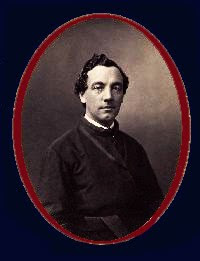
Today image is a photo of Patrick Francis Healy, SJ, President of Georgetown University from 1874 to 1882. Though I cannot find information on Georgetown's segregation policy at the time, I presume the university did not accept African-American students during his tenure. Presumking is always dangerous for historians and I would welcome further information.


