Showing posts with label Puritanism. Show all posts

Tuesday, April 7, 2015

Foundations of the Anglican Church CXIII


Christopher Wren's
magnificent Cathedral
of Saint Paul in London

From Sunday September 2nd until Wednesday September 5, 1666, a raging fire swept through the City of London.  Londoners from King Charles and his brother, the Duke of York, down to street vendors and rag-peddlars joined arm-in-arm fighting the appalling conflagration but without much success. Archeological evidence shows that the fire reached 3,092o Fahrenheit  (1700 degrees Celsius), virtually able to incinerate stone.   When The Great Fire of London was finally extinguished the “City”—the square mile within the old city walls—was gone.  Over 13,000 homes, 87 parish churches, and the great medieval Cathedral Church of Saint Paul were destroyed.  The fire gave the Diocese of London encouragement to redraw many parish lines as not all the destroyed churches were to be rebuilt, but the Cathedral, of course, had to be rebuilt. 
There had been talk even before the fire of rebuilding Saint Paul’s.  The vast medieval Cathedral,  the second largest church in medieval Europe after the Abbey of Cluny, was 586 feet in length, 100 feet wide, with a span of 290 feet at the transepts.  In its day it had been glorious with the highest spire and the best stained glass in England.  Ironically its construction had begun in the 11th century to replace an older cathedral destroyed by fire in 1087.  A 1561 fire had toppled the spire but left the cathedral itself undamaged, but that fire combined with the Puritan indifference to cathedrals had led to a century of decay.  With the Restoration of the Monarchy (and bishops) in 1660 the decision had to be made: restore or build anew.  The Great Fire put an end to the discussion, there was no longer a choice but to rebuild. 
The Architect chosen for the work was Christopher Wren (1632-1723), a brilliant polymath who was expert in geometry, anatomy, astronomy, and physics as well as an architect who would build or rebuild over 50 of the London Churches after the fire.  Wren’s initial design reflected the Protestant ideal of simplicity and an emphasis on hearing the Word with a cathedral designed primarily for preaching rather than for pageantry.  The design was initially accepted but with the 1660 Restoration of the monarchy and episcopacy certain shifts both in theology and taste had already begun to occur and the clergy mounted a campaign for a more elaborate—and traditionally formatted—building.  The clergy insisted on the Latin cruciform plan with nave, transepts, and a deep choir.  A second design was submitted, approved by the King, but still did not meet clerical standards.  A third and final design received the Royal Warrant but King Charles permitted Wren discretionary use to make alterations—“more ornamental than essential”—as the building proceeded.  The finished Cathedral bore little resemblance to the final plan as Wren used that discretionary power widely. 
One interesting story is that in laying out the design for the new cathedral, Wren sent a workman to fetch a stone, any stone, to mark the exact spot that would lie beneath the center point of the projected great dome that would rise over the crossing at the midpoint of the Cathedral. The worker brought him a fragment of a gravestone that had been in the pavement of the old cathedral and it was marked with the Latin word, Resurgam: “I shall rise.”  Wren was deeply impressed by this and took it as a sign of his Divine Mission to rebuild the cathedral. 
In the end he produced a magnificent building, and one that bespeaks the emerging via media of the 17th century Caroline Anglican tradition.  The cornerstone was laid on June 21st 1675 with Masonic rites.  While some critics complained that it “had an air of popery about it,” it really isn’t very Catholic at all, but neither is it very Protestant.  It is in the baroque style of the day but has an air of Protestant reserve rather than Catholic enthusiasm.   There was a wooden communion table, not a stone altar, at the eastern end of the choir.  Wren had wanted a proper altar beneath an elaborate baldachino—very much like what stands there today—but the Church of England was not about to go that “Roman” yet.  On the other hand, there was a traditional choir screen separating the chancel and altar from the nave.  The screen was removed in the 19th century to give the view of the chancel from the entire length of the nave.  The screen, or pulpitum as it is properly called, bore the great organ, a “Father Smith” organ (named after the great German organ builder of the day, Bernard Smith) in a case designed by Wren’s team and carved by Grinling Gibbons who was perhaps the finest artist to work in wood the world has ever known.  Gibbons also carved the magnificent choir stalls in the chancel.  The wrought iron work was done by Jean Tijou, the premier iron worker of his day. 
There is a humorous anecdote about the organ.  Wren didn’t want one in the church because he thought that the chancel screen to bear it and the organ itself would cut his cathedral in half and break that magnificent view from back to front.  But the clergy insisted on an organ.  The puritan days were over and there was to be no reserve when it came to good music in church.  Wren would always refer to the instrument as “that confounded box of whistles.”  In the nineteenth century the screen was taken down, the organ moved to the wall on the north side of the choir, and Wren’t desired view was finally opened.   
The construction of Saint Paul’s testifies to an Anglicanism searching to find its unique identity.  There was no desire to return to the Calvinism of Edward’s and Elizabeth’s days.  This was a cathedral built for processions and ceremony; while not for Catholic pomp, certainly for an English decorum.  It was at its heart, Protestant—a wooden communion table stood in place of an altar; but there was a Catholic attention to fine point, a persnicketyness even, in the detail of the carvings and ironwork and other décor.  While it was suited for preaching, it was designed for liturgy.  It reflected the theological shifts of the 1662 Book of Common Prayer and while the Oxford movement and its ritualism were still centuries off, so too the sacramental slovenliness of Puritan Anglicanism was left in an unremembered past.  But then London itself was being reborn as a European center in rivalry to Paris and its cathedral—and the religion it represented—could hardly be that Geneva Gown and Psalm singing cult of the days of James I.  Londoners were becoming less rigid ideologues and more cosmopolitan consumers.  

Thursday, March 19, 2015

Foundations of the Anglican Church CXI


A somewhat typical 17th century
Oxfordshire Communion Table

With the restoration of the monarchy and the episcopacy in 1660 and the subsequent imposition of liturgical conformity on the Church of England with the Act of Uniformity of 1662 there was an opportunity to make revisions in the Book of Common Prayer that set the form for the Anglican Liturgy.  The Savoy Conference of 1661 failed to reconcile the Presbyterian/Congregationalist faction which, in rejecting the Act of Uniformity, went on to become separate Churches and this separation, in turn, permitted the High Church wing of the Church of England to make several revisions in the Liturgy that stressed its Catholic heritage.  You may remember that one of the things that triggered the Civil War and the abolishment of both monarchy and episcopacy (in 1649 and 1646 respectively), was Archbishop Laud’s attempts to push some liturgical changes that departed from the puritan/Calvinist theology in favor of more a more ancient (read: Catholic) approach. 
The words “bishops,” “pastors,” and “ministers” were to be replaced in most instances with the terms “bishops,” “priests,” and “deacons.”  In the Liturgy itself, a prayer for the departed was inserted into the prayer for the Church Militant and while it was not so much intercessory as it was commemorative it is still a most noteworthy addition as it marks the first such commemoration of the faithful departed since the 1549 Prayer Book was superseded by the 1552 edition.   
There was also a re-introduction of the idea of “offertory” with the insistence that the alms be placed on the holy table alongside the bread and wine with the accompanying prayer: “We humbly beseech thee to accept our alms and oblations…   Previously there was no mention of placing the elements on the holy table though obviously they had to get there somehow.  Their inclusion alongside the alms—which had formerly been placed directly in the poor-box—signifies an idea of the people offering their gifts and word “oblations” gives it a sacrificial connotation.     
The “Black Rubric” which had insisted on kneeling for Holy Communion, but insisted also that the kneeling should not imply the Real Presence much less adoration of the Sacrament had been dropped in the 1559 Prayer Book.  It was now introduced in an altered form to read
"Whereas it is ordained in this Office for the Administration of the Lord's Supper, that the Communicants should receive the same kneeling; (which order is well meant, for a signification of our humble and grateful acknowledgment of the benefits of Christ therein given to all worthy Receivers, and for the avoiding of such profanation and disorder in the holy Communion, as might otherwise ensue;) yet, lest the same kneeling should by any persons, either out of ignorance and infirmity, or out of malice and obstinacy, be misconstrued and depraved: It is hereby declared, That thereby no adoration is intended, or ought to be done, either unto the Sacramental Bread or Wine there bodily received, or unto any Corporal Presence of Christ's natural Flesh and Blood. For the Sacramental Bread and Wine remain still in their very natural substances, and therefore may not be adored; (for that were Idolatry, to be abhorred of all faithful Christians;) and the natural Body and Blood of our Saviour Christ are in Heaven, and not here; it being against the truth of Christ's natural Body to be at one time in more places than one."
As Protestant as this might sound, there is a significant shift from the 1552 text which read
… Lest yet the same kneeling might be thought or taken otherwise, we do declare that it is not meant thereby, that any adoration is done, or ought to be done, either unto the sacramental bread and wine thereby bodily received, or to any real and essential presence, there being of Christ’s natural flesh and blood.”
 Whereas in the 1552 text, it is denied that Christ is really and essentially present, the 1662 text denies the corporeal presence of Christ’s natural flesh and blood.  We Catholics can easily miss the distinction, but it would be very clear to a 17th century Protestant.  The 1662 text is ambiguously worded to permit belief in the Real and Essential Presence of Christ as long that Presence is not confused with his physical Body that was Raised from the Dead and has ascended into heaven and has taken his place at the right hand of God.  In other words, while the 1552 text insists that Christ is present only in a spiritual or commemorative sense, the 1662 Book permits belief in a Real but not a corporeal Presence.  This distinction is strange to us Catholics, but it would be a crucial shift in theology for English Protestants of the time. The 1662 text was wary of a physicalist understanding of Christ’s Presence in the Eucharist but it was not denying that Christ was truly Present in a sacramental sense even as we might find him truly present but not physically present to us in moments of intense prayer.  This might even be compared to what Saint Teresa of Avila writes about the presence of Christ in a vision where he is, the Saint says, present but not corporeally. 
We Catholics, of course, believe that the Presence of Christ in the Eucharist is a corporeal presence and that, in fact, the bread and wine of the Eucharist have been transformed into the true flesh and true blood of the Risen Lord, indistinguishable from the flesh and blood that was conceived in the womb of the Virgin Mary, that died upon the Cross, and that was raised from the dead.  This revised text in the 1662 Book does not meet Catholic orthodoxy, but it does mark a significant step away from the Zwinglian understanding of Eucharist as memorial to an eating and drinking of Christ’s sacramental (as distinguished from physical) Presence.
Catholic theologians of the period had lost the intrinsic connection—so clear in the Eucharistic theology of Saint Augustine—of the Eucharistic Presence of Christ and the Ecclesial Presence of Christ (The Church as the Body of Christ)—and of the Ecclesial Presence of Christ with the Physical Body of the Risen Christ.  The 1943 Encyclical Letter of Pope Pius XII, Mystici Corporis, has helped us recover our awareness that we, as Church, are the Risen Body of the Lord, but the imagination of most Catholics even today restricts the Presence of Christ’s Body to the Eucharistic Bread and Wine.  For them, Christ is in heaven and he is in the tabernacle and nowhere else.  Consequently their belief in the Real Presence becomes an assertion in his Real Absence from our daily lives and leaves us with a very truncated understanding of both the Eucharist and the Church as well as a highly disempowered Christ who has no involvement with the world in which we live but only in the world that awaits us beyond death.  This distortion of Christ reduces his kerygma of the Kingdom of God to the post-mortem paradise and frees the believer from taking any responsibility for this world beyond his or her own moral righteousness.  Ironically this leads to the same over-spiritualization of the Christian faith that results from the purely Spiritual understanding of the Eucharist that has permitted the bi-level morality of Protestant/Capitalist Western Society.  There is no social sin, only personal sin because God has no investment in human society.  But enough of that.  I tend to digress, but thank you Max Weber for your insights about The Protestant Ethic and the Spirit of Capitalism. 
In addition to the text of the Liturgy, there were a number of rubrical changes.  The priest was required to wear as a vestment the surplice and not simply the black gown preferred by the Puritan wing.  The priest was also required to take up the bread and wine in his hands during the Words of Institution (Words of Consecration) and break the bread as he speaks the words.  These “manual acts” imply the priest consecrating the bread and wine as he reenacts the actions of Jesus while speaking Jesus’ words.  Perhaps the most dramatic revision was that whatever consecrated bread and wine remained after the Holy Communion were to be reverently placed on the Holy Table and covered with a fair linen cloth until after the service, at which time they were to be reverently consumed.  Previously the Eucharistic remains were to be given to the priest for daily use.  This rubric suggests that the “real and essential” (though not-corporeal) Presence remained, or perhaps better that the Presence was an objective reality regarding the bread and wine and not merely the subjective apprehension of the believing communicant. 
As to other matters, there is no mention of cross or candles upon the Holy Table and the Holy Table is still to be positioned in the chancel—supposedly in its accustomed spot in the center—with the priest standing on the north side.  In fact, more and more the Holy Table was placed in Laud’s preferred position at the east end in the traditional positioning of the pre-Reformation altar.  Normally, however, in this position the priest still stood at the north end of the table (which in its eastward positioning was no longer a long side); it would be some time before priests resumed the eastward facing positioning as it was important to the Prayer Book mentality that the “manual acts” of the priest breaking the bread and holding the cup be visible.  
The Service of Holy Communion was unquestionably Protestant but it was no longer a Zwinglian commemorative meal.  Freed of Puritan influence, the Church of England was free to chart a new course.  It would over the next century and a half take steps in several different directions.  

Monday, February 2, 2015

Foundations of the Church of England CVI


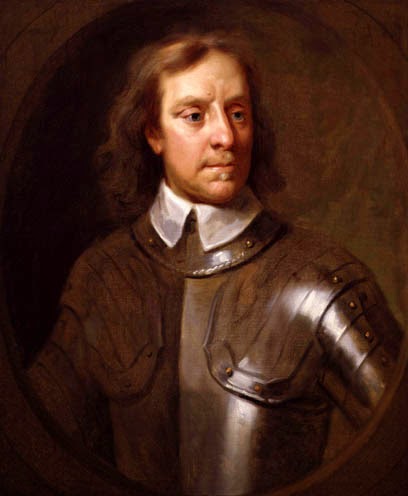
Oliver Cromwell, leader 
of the Puritan faction and 
Lord Protector of England
after the abolition of the 
monarchy

There is a lot that I want to get to.  I want to follow up on the French and Anti-Semitism theme with the connections between Anti-Semitism and Catholic “Traditionalist” movements as well as Political Monarchism and Catholic Traditionalism.  Then I have a lot of material on the dissatisfaction of the Traditional wing-nuts with Pope Francis, and the whys and wherefores of their anger for the Pope, as well as how the Pope’s political agenda—Income Inequality, Climate Change, etc—are fueling the neo-traditionalist anger towards him.  I still have two more posting’s on the Pope’s Christmas message to the Curia.  And I have yet to finish my series on the Katholic Krazies.  And in the midst of all this, Pope Francis and others keep making the news. 
But let’s go back, at least for today, to my Church of England series.  I bit off more than I could chew when I picked that topic, but we are too far into it to abandon it and while it elicits fewer hits than my occasional skewering of Cardinal Burke and other primping prelates, it has a committed and loyal leadership to keep letting me know how much they appreciate it.
So we left off with the English Civil War. Parliament abolished episcopacy (government by bishops) in 1646 and the monarchy in 1649.  (James I was right: no bishop, no king.)  With the abolition of bishops, the Church of England became Presbyterian in government, but would actually best be described as what we Americans know as “Congregationalist.”  The Book of Common Prayer and its liturgical forms were discarded in favor of The Directory For Public Worship which was borrowed from the Scots Tradition established by John Knox almost a century before.  The purpose was to purify any elements of “Romish” doctrine, practice, or superstition from Reformed worship.  The “rule of thumb” was that for anything to be done in public worship, there must be an explicit warrant for it in the New Testament.  This rule, while applied strictly, was also applied somewhat uncritically as historical primitive church practice was, in fact, little known in the 17th century and there was often a sort of sentimental projection backwards of a certain ideology/idealism onto a romanticized primitive Church.   Archbishop Laud’s restoration of altars (usually wooden tables but covered with rich hangings) in the former chancels, along with cross and candles that had re-appeared in some places, were all done away with, while plain wooden communion tables re-appeared.  Where copes or even surplices had been used, they too were suppressed and the ministers wore simply their black academic gown.  There was no pronouncing of the absolution after a confession of sinfulness, no recitation of the doxology, no use of the Nicene or Apostles Creeds, no liturgical seasons (Advent, Lent, etc.)  or feasts (including Christmas, Easter, Pentecost).  There was no Confirmation service, no provision for Holy Communion for the sick, and no giving of a ring in marriage.  The only hymns that could be sung were metric psalms, and some were opposed to even these.  In fact, some ministers or congregations refused to use even the Lord’s Prayer, rejecting any set words for prayer.  There was no burial service lest the appearance be given of prayers for the dead, but the minister could give a sermon on the occasion of a funeral admonishing the living to keep in mind their impending call to stand before the Throne of Judgment. and civic honors could be paid to the deceased according to the dead person’s station.    Baptism was never to be administered privately but only on the occasion of Sunday Worship and even marriage were ideally to be part of the Sunday Service.  Sunday Worship—indeed even daily worship where it was held—was to consist of scripture readings—an entire chapter of the Old Testament followed by an entire chapter of the New (and the books of the bible were to be read in sequence and not according to the abolished seasons and feasts)—followed by a long prayer by the pastor.  This, in turn, was followed by the sermon which lasted an hour or more and was to be an exhortation for people to repent from their sinful ways.  Finally there was to be a collection for the poor.  Holy Communion was to be administered “frequently” but this usually was interpreted to mean quarterly—every three months.  Holy Communion, when it was held, followed the sermon.  The minister would then read Saint Paul’s account of the Eucharistic Tradition that he himself had received (I Corinthians 11:23-26).  This was followed by a fairly long prayer asking, among other things, that through these gifts spiritually received the communicants might dwell in Christ and Christ might dwell in them.  The bread and wine were then distributed to those congregants who had remained after the morning sermon and had been approved by the minister for Holy Communion.  In some of the more rigidly administered churches communicants sat around the communion table set up in the front of the church; in others they received bread and wine passed to them in their pews.   The Anglican posture of kneeling for Holy Communion was done away with in favor of an insistence that communicants remain seated. 
Even in the more Protestant parts of the nation—London, Norwich, the south-east—the changes were not well taken by the majority of the people.  Indeed England was somewhat unsettled both politically and religiously under Oliver Cromwell’s being “Lord Protector.”  Conformity was enforced by military strength and where it could not be so enforced—rural areas, the north, and the west, the Prayer Book Liturgy—albeit without the Laudian accouterments—often surreptitiously survived.  The Burial Office was particularly popular as the official rites had been so stripped down that many people felt totally unconsoled by them.
Despite the radical turn to the most severe Protestantism, it was not far enough for some.  Even before the Civil War there was a faction among the English Puritans that began to hold the necessity of a faith-filled encounter with Christ that must precede baptism.  This idea that the believer must first accept Christ and commit himself to Christian discipleship before one could be baptized obviously ruled out infant baptism—a practice of the Church from very early in its history.  While there had been Anabaptist movements (Anabaptist from the Greek ἀναβαπτισμός, re-baptized or baptized over again) in Germany from the time of Thomas Müntzer (preached 1521-1525)  Anabaptist doctrine had spread widely on the continent throughout the sixteenth century, its first appearance for the English was in the English émigré community in Amsterdam where one-time Anglican Priest, John Smyth, had broken with the Church of England because he was opposed to the idea of a State Church, that is the political control of the State over a Church.  By 1609 Smyth had come to believe that one must acknowledge Christ as Lord and Savior before one could be baptized.  Smyth re-baptized himself and then his followers.  Smyth never returned to England and in fact sought to join the Mennonites, a religious community in Holland (and elsewhere in Europe) that also practiced believer’s baptism.  After Smyth’s death, however, a portion of his flock returned to England.  Other Anglicans, all of the Puritan faction, also came to hold believer’s baptism.  John Spillsbury was a shoemaker who belonged a church that followed Smyth’s teaching that the Church must be independent of the State (they were known as Separatists)  and he also held for infant baptism.  In 1638, on the eve of the English Civil War, Spillsbury set up his own church which not only practiced believer’s baptism but insisted that baptism must be by full immersion, that is the baptized person must be brought totally under the water and not simply have it poured over him or be sprinkled with it. 
Like others of the extreme Puritan wing, these Baptists (as they came to be known) rejected any of the liturgical practices of the Church of England which they saw as holdovers from the Church of England’s Catholic past.  Worship was totally without form and spontaneous.  Some even forbad the reading of the scripture during worship, claiming that since the scriptures were being read in translation they were “the work of men and not of God.”  Hymns were forbidden, though psalms—including those in metrical form—could be sung.  There were to be no organs in their meeting houses, nor candles (except, of course, for lighting), crosses or other ornaments.  The ministers wore plain street clothing or, if they had matriculated at university, their gown.  Baptism and Holy Communion were the only “ordinances” (the word “Sacrament” being too Catholic). 
With the collapse of the Episcopacy in 1646, such chaos resulted in the Church of England that the Baptist congregations were not only, for the most part, unharmed but unnoticed.   They looked like the Puritan (Congregationalist) congregations in every respect except for their mode of baptism.  Consequently they were able to grow unmolested.  They never became particularly big in England, though they did have considerable success in Wales.  Meanwhile, their ideas spread to the North American colonies, and especially Puritan Massachusetts, where they did meet with persecution from the predominant Congregationalists in the colony.  Massachusetts dissidents fled to Rhode Island where they shaped the colony in a slightly different way, arguing both for freedom of conscience and separation of Church and State.  The Baptist movement in North America would only really take off in the Second Great Awakening, a religious revival movement in the early 19th century, but American Baptists have always been stalwarts on the separation of Church and State.  Classically Baptists have also been in favor of freedom of religion but in the current culture war environment that is eroding in some quarters.  More on the Baptists at some future time.  

Wednesday, January 14, 2015

Foundations of the Church of England CIV


Charles I
We haven’t finished with the Caroline Divines but as they span the better part of the 17th century we are going to intersperse postings on them with what was going on politically and religiously to shape the Church of England.  To understand the next phase of development in the Church of England we need to take a look at the English Civil War and to understand the Civil War we need to keep a few things in mind.
1.     There was as yet no Great Britain.  There were the separate kingdoms of England (and Wales) and Scotland.  (There was also the Kingdom of Ireland, but as that is on a different island and as in this phase of the development is not germane to our story, let’s just put it aside for the moment.)  England and Scotland were separate kingdoms with separate parliaments and separate Churches, but James VI (of Scotland) & I (of England) was king of both Kingdoms.  He was succeeded upon his death by his son Charles who also ruled each kingdom. 
2.     The Scots did not have as strong a parliamentary tradition as did the English and the English grew fearful that under these Scots Kings, the monarchy would grow stronger at Parliament’s expense. 
3.     James and his son Charles were highly influenced by the theory of the “Divine Right of Kings” that they held their thrones from God and ruled by his authority regardless of the consent of the people or the parliaments of their kingdoms.
4.     In England the king could not levy taxes without the consent of Parliament.
5.     The Church of England had always been an Episcopal Church (governed by bishops) and had since the reign of Elizabeth been strongly Calvinist in its theology.  However there was a strong faction in the Church of England that wanted Presbyterian government (Boards of Clergy replacing bishops in setting policy) which was more typical of the Calvinist tradition.  The Church of Scotland, on the other hand, had been Presbyterian but James had gradually re-introduced bishops to it, over and against the preferences of most of its staunchly Presbyterian members.  By and large, Scotland was not happy with bishops. 
6.     During the reign of King James and especially after the accession of Charles, there developed a faction in the Church of England that theologically and liturgically began to move away from the Calvinism that characterized Anglicanism since Cranmer and particularly since the reign of Elizabeth.
7.     James reputed homosexuality and his attachment to a number of “favorites,” especially George Villiers, Duke of Buckingham, caused significant scandal to the Puritan (Calvinist) faction of the Church of England.   Given James’ piety and general good nature, it pretty much only remained as grumbling during his reign, but when Charles ascended the throne and kept Buckingham as a chief advisor, the Puritan faction began to openly challenge royal policy. 
8.     Charles’ marriage to the openly Catholic Henrietta Marie, a French princess, angered the Puritan faction, not only because she was a Catholic but because of the persecution of French Calvinists by the Crown in France. 
The pot came quickly to a boil in the reign of Charles.  He became king in 1625 and by 1628 the English Parliament was determined to limit his power with the “petition of right.”  Charles needed Parliament to grant him new taxes to support English participation in the Thirty-Years War.  This was an essentially Catholic-Protestant War and England was to come in on the Protestant side, but Parliament used the King’s need to wring from him agreement that
1.     the King would not levy taxes without parliamentary consent
2.     soldiers would not be billeted in private homes without the owners’ consent
3.     martial law would not be imposed to quell political unrest
4.     Englishmen would not be arbitrarily imprisoned for dissent from royal policy
Charles had no choice but to agree to the petition, but he determined not to call Parliament again and for eleven years ruled without it.   Tensions mounted.  We mentioned Archbishop Laud and his revival of a certain amount of ceremonial in the Church of England and this did not sit well with the Puritan faction.  Laud and other High Churchmen also renounced the Calvinist doctrine of double predestination in favor of Free Will.  Laud also enforced the laws on Church attendance, fining or imprisoning those Puritans who refused to attend the Prayer Book liturgy.  Those who criticized the Archbishop and his leadership of the Church, were dragged before Church courts which had the right to various punishments such as lashings or cutting off of an ear.   Laud’s unpopularity with the Puritan faction—which was also the Parliamentary faction—only increased the unpopularity with King Charles.
When Charles and Laud tried to force a new Prayer Book on the Church of Scotland—a very “High Church” Book (for the day) rebellion broke out in Scotland with the so-called “Bishops’ Wars”  (There were actually two, on in 1637 and the other in 1640.)  Charles ended up being trounced by the Scots and he needed money to pay the war debts.  This led to the calling of Parliament in April 1640.  Parliament, once assembled, was not about to limit itself to voting the needed revenues for the King, but began to debate their grievances against the King.  Charles dissolved Parliament after only three weeks.  This was the “Short Parliament.” 
Charles turned to Ireland for revenues where his viceroy, Lord Wentworth, was able to raise funds by persuading the Irish Catholic Lords to vote the King funds in return for greater religious liberty for Catholics.  Trust me, this only enraged the Puritan faction all the more.  Emboldened by the new monies, Charles could not stop himself from poking the hornet’s nest and once again invaded his Scots Kingdom to assert his authority.  Once again he got trounced.  To keep the Scots from invading England he had to pay the Scots army £ 850 a day.  He also had to fund his English army to defend England against these Scots.  In other words, he was paying to support both sides in a war.  Desperately short of funds, he had no choice but to call Parliament again in November 1640.  This Parliament had cojones.  It arrested Laud in 1640. It would have him executed in 1645.  It convicted Wentworth (the fellow who raised the money for Charles in Ireland) of treason and executed him in 1641.  It passed a Law that the King could not dissolve Parliament without its consent.  It passed another Law that Parliament had to meet at least every three years.  It declared that the King’s advisors were subject to Parliamentary review.  It abolished the Courts of High Commission and Star Chamber—two of the Courts subject directly to the King.  In 1646 this parliament—known as the “Long Parliament”—abolished episcopacy making the Church of England Presbyterian in government.    To be cont.